
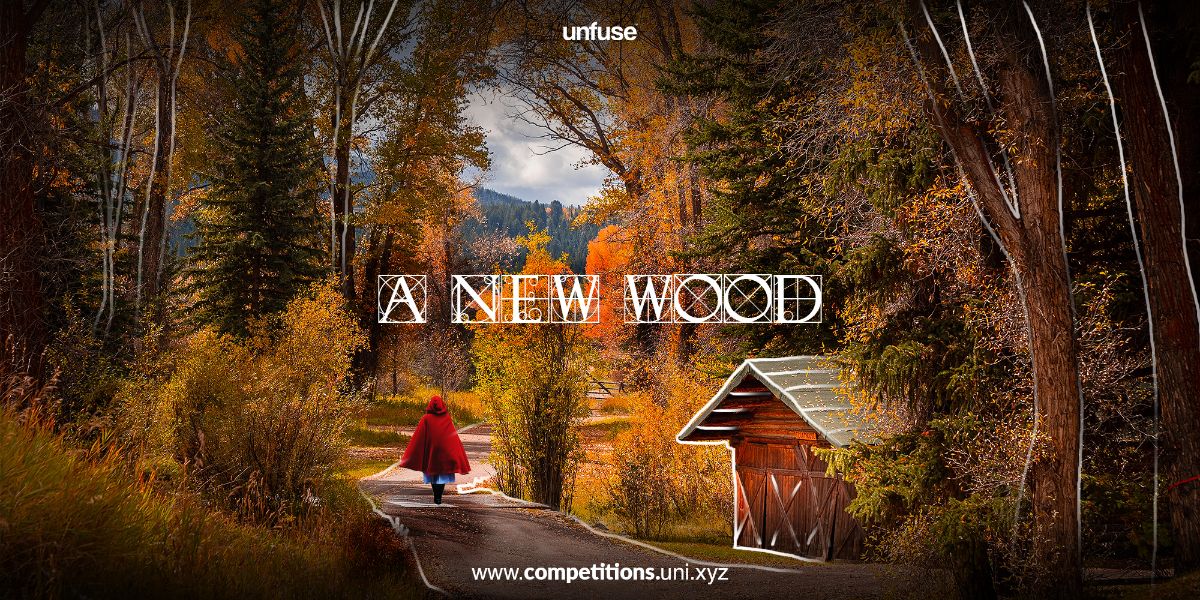
A New Wood – Re-imagining Red Riding Hood’s Journey through Architecture

The spontaneous and natural tangle of forest formations is the exact opposite of the organized reality of built and urbanized spaces, dictated by reason and therefore perfectly decodable by it. NATURE AND META-NATURE
In its double symbolism, the nocturnal one of impenetrable, disturbing, hostile and dangerous and diurnal, luxuriant teeming with life and uncontaminated, pleasant and restful, the woods are both: the place of nothing, the labyrinth or the labyrinthine inner loss and the place of transitions. The place of life and that of death.
Between physical forest and the inner forest is the woods in the fairy tale of Little Red Riding Hood even if according to the original fairy tale, the forest is necessarily a transition point to get, avoiding the dangers, to the grandmother’s house. If the wood is to be understood as a smaller and perhaps more “domestic” physical place than that of the forest, the inner woods can be cataloged in some places such as that of contemplation and quiescence of loss, an imaginative place (due to intermittent darkness) without rules and place of maturation and knowledge.
The tale of Little Red Riding Hood, following the mother’s instructions, invites us to experience the woods as something to run away from, a place where you don’t have to entertain yourself in order to arrive, without detours and dangers, directly to the grandmother’s house which is “apparently” their goal of the story.
But the forest is then necessary, the inner journey is therefore also, symbolized by the forest, necessary. The objective, the aim cannot be separated from the path that anticipates it and together they constitute a single body, the body of human beings and that of nature which cannot be separated.
The path therefore in its various imaginary sequences (being a fairy tale) can become the element on which to focus the maximum attention, overturning the very meaning of the story, that is to say, concentrating on the idea of the path as a short text ” Der Feldberg” by Martin Heidegger suggests “.
The aim of this competition is to push forward the imagination about a very classic novel questioning if the path is important or just the final destination the only purpose to be pursued. The same difference exists between a tourist and a traveler. Should be our little girl enjoy the path (including any possible danger) before to get to her grandma’s house or to get there directly, following her mother’s instructions? How would you describe the path in the wood in a term of a visionary map including the grandma house project? Which place is Home?
Short Description
The competition is about re-imaging a novel: a new wood and wooden house for little red riding hood.
Organizer
UNFUSE
Link to Competition

Link to Registration form
Prizes
Prize pool of worth 20,000$
First Prize: 5000$ (For students and professionals)
Runner Up: 6 x 1100$ (For students and professionals)
People’s Choice: 4 x 600$ (Open for all)
Honorable Mention x 12: 500$ Each
Type of Competition
Open to the public/Minimum requirements (Open to anyone that complies with the requirements), Single stage (Winners selected immediately)
Who can Participate
Minimum eligible age for participation is 18 years.
There is no restriction on the degree of design disciplines to participate in the challenge.
Participation in the competition can happen in a team as well as an individual.
Maximum numbers of participants in a team are 4
Dates and Time Frame
Registration Closes May 25, 2020
Deadline to Submit Project June 9, 2020
Winners announcement Date August 6, 2020
Languages
English
Location of Competition
Germany
Additional Information
