
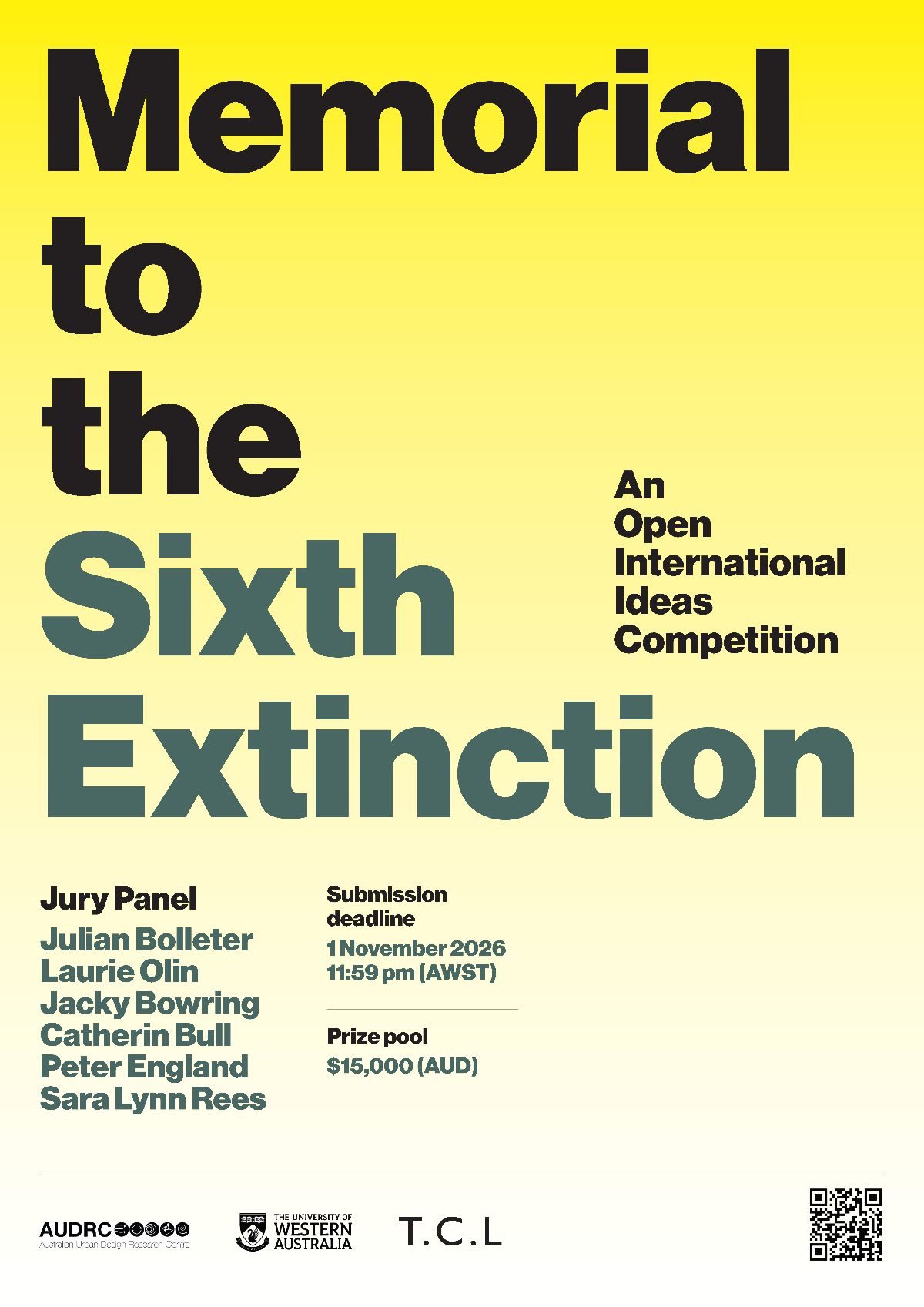
Memorial to the Sixth Extinction – An Open International Ideas Competition
Background
“There have been five major extinction events in the Earth’s history, the fifth being the case of the dinosaurs eliminated by an asteroid crashing into the Yucatan peninsula some 65 million years ago. While horrendous for the dinosaurs, their sudden absence gave small marsupials an ecological opportunity and opened up an evolutionary pathway that ultimately led to humans. Able to outrun and outwit animals, humans chewed their way through the megafauna of most continents and now, by grinding down their habitats for farms and cities, we seem intent on extinguishing the rest. This is known as the sixth extinction, and its grim ledger is the IUCN Red List of Threatened Species.
Resistance to this biological holocaust has underpinned the global conservation movement, which, since the mid-20th century, has focused on creating protected areas—large patches of land from which destructive and extractive human activities are excluded. In 1962, there were 9,214 protected areas globally; today, there are over 266,000, amounting to a grand total of 15.6% of the earth’s terrestrial area and almost 6.5% of the world’s oceans.
In terms of helping to mitigate the sixth extinction by creating safe havens for threatened animals and plants, the future of protected areas faces two major challenges. The first is that protected areas do not map accurately onto the world’s most threatened biodiversity and the second is that where they do the land areas are not large enough to facilitate the movement of species as they now seek to adapt to global warming. Seriously addressing these two challenges means reorganizing land use in a coordinated manner, on a planetary scale. To that end, at the 2022 United Nations Biodiversity Conference (COP15) 188 nations agreed to a new target of placing 30% of the earth’s terrestrial area under protection.
Evolution waits for no species. Over the course of a few million years or so, every species effectively becomes extinct—either they naturally evolve into something else, or, as fate would have it, they are eliminated by competitors, disease, or some other form of environmental calamity. For many plant and animal species today, humans are now the greatest threat to their survival. Human activity is the equivalent of a slow-motion asteroid. And yet, it is only the human who has the capacity to prevent a real asteroid hitting the Earth.”
Richard Weller
To the Ends of the Earth
(Birkhäuser, 2024)
The Brief
The challenge of this ideas competition is to create a physical memorial to the Sixth Extinction—a global event that has happened, is happening, and is also yet to happen—one that doesn’t remember or edify the human subject as most memorials do but rather questions the human as nature’s self-appointed executioner. Your memorial design can be any size and can be sited anywhere.
Submission Requirements
1. One A2 (portrait) panel showing the concept of your memorial.
2. One A1 (landscape) panel showing the design on the site and including a scaled plan and section.
3. A supporting statement of up to 300 words of text (on either panel) explaining your design and justifying your choice of site.
Submission Deadline
Designs must be submitted electronically (using the competition portal www.surveymonkey.com/r/SRGG9H9 ) by 11:59 pm (Australian Western Standard Time) on 1 November 2026. There is no fee for entry.
Jury Panel
Julian Bolleter, Director, Australian Urban Design Research Centre, the University of Western Australia (Jury Chair)
Laurie Olin, Founder of OLIN and Professor of Practice, University of Pennsylvania, USA
Jacky Bowring, memorial design specialist and Professor of Landscape Architecture, Lincoln University, New Zealand
Catherin Bull, Emeritus Professor of Landscape Architecture, University of Melbourne and Adjunct Professor, Queensland University of Technology
Peter England, Tony Award-nominated theatre and live production designer
Sara Lynn Rees, Palawa woman descending from the Trawlwoolway people of north-east Tasmania, Lecturer at Monash University and Co-Chair of the Australian Institute for Architects First Nations Advisory Working Group.
Who Can Enter
The Memorial to the Sixth Extinction Ideas Competition is an open international competition. Entries are accepted from students or professionals worldwide. We anticipate most entrants will come from the fields of architecture, landscape architecture, urban design and fine arts, although we welcome entries from other relevant disciplines. We encourage multidisciplinary teams of up to six participants.
About the Competition
This competition was conceived by, and is held in the memory of, Richard J. Weller (1963–2025), designer, author and emeritus Professor and Chair of Landscape Architecture and Urbanism at the University of Pennsylvania, USA. Richard was also a professor and former director of the Australian Urban Design Research Centre at the University of Western Australia, the host of this competition.
Throughout his lifetime Richard’s design work was frequently awarded in international competitions and exhibited at the Venice and Rotterdam Architecture Biennales; the Guggenheim Museum, New York; the MAXXI National Museum of 21st Century Art, Rome; the Isabella Stewart Gardner Museum, Boston; the Canadian Design Museum, Toronto; the Central Academy of Fine Arts, Beijing; and the Museum of Contemporary Art Australia, Sydney, among others. He is the author of ten books including Room 4.1.3: Innovations in Landscape Architecture (University of Pennsylvania Press, 2005), Made in Australia: The Future of Australian Cities (UWAP, 2013), Design with Nature Now (Lincoln Institute of Land Policy, 2019), An Art of Instrumentality (ORO Editions, 2023), and To the Ends of the Earth: A Grand Tour for the 21st Century (Birkhäuser, 2024). However, Richard’s enduring legacy may well be found in his research and writing on global flashpoints between biodiversity and urban growth, published in National Geographic, Scientific American and documented on the web-based platforms Atlas for the End of the World, The World Park, and The Hotspot Cities Project, where he makes a compelling case for the critical role that designers can play in protecting the Earth’s biodiversity and pursuing a more sustainable future.
About the Organisers
The Memorial to The Sixth Extinction Competition is funded by the Kevin Taylor Legacy, a creative grant in memory of Kevin Taylor, one of Australia’s leading landscape architects and hosted by the Australian Urban Design Research Centre (AUDRC) and the University of Western Australia’s School of Design. The grant program was established in 2014 by the multi-award-winning Australian landscape architecture firm, T.C.L.
Suggested Readings
1. Richard Weller, Claire Hoch & Chieh Huang, Atlas for the End of the World.
2. Richard Weller, The World Park Project, McHarg Center for Urbanism and Ecology, University of Pennsylvania.
3. Anna Tsing, et al (eds), Arts of Living on a Damaged Planet: Ghosts and Monsters, University of Minnesota Press (2017).
4. Elizabeth Kolbert, The Sixth Extinction: An Unnatural History, Picador USA (2015).
5. Jacky Bowring, A Field Guide to Melancholy, Oldcastle Books (2008).
6. Richard Weller, The Hotspot Cities Project, McHarg Center for Urbanism and Ecology, University of Pennsylvania.
7. Michèle Woodger & Tszwai So, Remembrance Now: 21st Century Memorial Architecture, Lund Humphries (2023).
8. Richard Weller, To the Ends of the Earth: A Grand Tour for the 21st Century, Birkhäuser (2024).
9. Chris Bessemens, “The Memorial Design Paradox,” The Journal of Architecture (Jan 2026).
10. Adrian Forty & Susanne Küchler (eds), The Art of Forgetting, Berg (1999).
11. Spencer Bailey, In Memory Of: Designing Contemporary Memorials, Phaidon (2020).
12. Shannon Davis & Jacky Bowring, “Connecting with Tragedy through Landscapes of Memory: Memorial Design, Tourism, and the Post-Genocide Memoryscapes of Cambodia, Rwanda, and Germany,” memoryconnection.org (2011).
13. Jennifer R. Wolch & Jody Emel, Animal Geographies: Place, Politics, and Identity in the Nature-Culture Borderlands, Verso (1998).
14. Richard Weller, Zuzannah Drozdz & Sara P. Kjaersgaard, “Hotspot Cities: Identifying Peri-Urban Conflict Zones in the World’s Biodiversity Hotspots” (2019) JoLA: Journal of Landscape Architecture, 36–47.
15. Richard Weller, “A New Beginning” Domus #1031 (January 2019), 18–27.
16. Albrecht, G., et al, “Solastalgia: the distress caused by environmental change” Australasian Psychiatry : Bulletin of Royal Australian and New Zealand College of Psychiatrists, 15 Suppl 1 (2007), S95–S98.
17. Renee Lertzman, Environmental Melancholia: Psychoanalytic Dimensions of Engagement, Routledge (2015).
18. Thom van Dooren, Flight Ways: Life and Loss at the Edge of Extinction, Columbia University Press (2014).
Q & A
Q: What will the judges be looking for?
A: Conceptual rigour, research, novelty, ingenuity and how well the design answers the brief of a memorial to the sixth extinction.
Q: Does my design have to be sited on planet Earth?
A: Not necessarily, but you will need to justify your site in your supporting statement.
General
• In the case of disqualification, entrants will NOT be notified.
• Jury processes and deliberations are confidential, and the decisions of the jury process are final.
• The information in this document and on the submission platform forms part of these Conditions of Entry.
• You must accept the Conditions of Entry to enter the competition.
• The competition organisers reserve the right to amend this document at any time, without notice.
• This version of the competition brief was issued on 15 May 2026.
Submissions and Use of Submitted Materials
• Submissions will only be accepted from eligible entrants who have submitted their anonymised entry digitally through the competition platform (https://www.surveymonkey.com/r/SRGG9H9) by the closing date (11:59 pm Australian Western Standard Time on 1 November 2026).
• Submissions must conform to the page/sheet dimensions and the instructions described in this document. Non-conforming submissions will be disqualified.
• Entries must be submitted as a single .pdf file including all three elements of the submission requirements (A2 portrait panel; A1 landscape panel, Supporting statement). Files must be under 16MB.
• No physical/mailed submissions will be accepted.
• Submitted materials shall not be released nor exposed to the public, press, or other media (including social media) before the announcement of the winning entries. • Entrants who violate this condition will be disqualified.
• No information contained in submissions shall be deemed confidential; therefore, please do not submit any information that may be considered proprietary in nature.
• The AUDRC and its sponsors or affiliates shall not be liable for any costs incurred by any entrant in the preparation of a submission.
• By entering the Memorial to the Sixth Extinction competition, you warrant that your submission does not include any images or text infringing on a third-party copyright, trademark, or other intellectual property right.
• By entering the Memorial to the Sixth Extinction competition you grant the UDRC, UWA and Kevin Taylor Legacy a free license to use, publish, distribute, and make derivatives of the submitted materials, in whole or in part, in connection with judging, promotion, review, publication, and exhibition of the competition and for future publications, and for archival and other purposes, in any format including print, digital, and online.
• The AUDRC, has complete discretion over how submitted materials (including images, derivatives of images, supporting texts, and fonts) are adapted or used in any publication, exhibition, or promotion. The AUDRC may crop, alter, adapt, or reformat images, replace fonts, and edit or change text to conform with the overall aesthetic, style, and with other layout and editorial considerations of any publication or exhibition, and for promotional or review purposes, without notice to the entrant.
• The AUDRC may request high resolution files from awarded entrants for the purpose of making font changes, formatting changes, text corrections, image resizing, or other necessary changes required for publication or exhibition.
Short Description
The challenge of this ideas competition is to create a physical memorial to the Sixth Extinction—a global event that has happened, is happening, and is also yet
to happen—one that doesn’t remember or edify the human subject as most memorials do but rather questions the human as nature’s self-appointed executioner. Your memorial design can be any size and can be sited anywhere. Deadline for submissions is 01/Nov/2026.
Organizer
University of Western Australia, Australian Urban Design Research Centre and TCL
Link to Competition

Link to Registration form
Prizes
The competition has a total prize pool of $15,000 (AUD), to be split among winning entries, as decided by the jury. Up to 10 honourable mentions will also be awarded, each receiving a certificate. All awarded work, along with select other entries, will be promoted on the competition website and in a potential exhibition.
Type of Competition
Open to the public/Minimum requirements (Open to anyone that complies with the requirements), Single stage (Winners selected immediately)
Who can Participate
• The Memorial to the Sixth Extinction ideas competition is open to tertiary students currently enrolled in an undergraduate or postgraduate program at a university or technical college, as well as professionals (of any level of experience).
• Individuals and teams of up to six (6) participants may make entries.
• Employees of the host organisation, jury members and their spouses/partners are not eligible to enter.
• Faculty, students, and employees from jury member organisations are eligible to enter.
• Entries will be judged anonymously. There must be no identifying information (that is, information that identifies individuals, organisations, schools, groups, or firms associated with the entry) on the images, in the image file names, or in the accompanying statement or text. Non-conforming entries will be disqualified.
• Jurors are required to immediately advise the competition organiser and recuse themselves from voting on a particular submission if they believe they recognise the identity of an entrant from the submission.
• Any entrant who violates these rules and any non-conforming entries will be disqualified.
Dates and Time Frame
Registration Closes November 1, 2026
Deadline to Submit Project November 1, 2026
Winners announcement Date
Languages
English
Location of Competition
Perth, Australia
Location of Project (if developed)
Any size and be sited anywhere
Additional Information
Banner, Poster, Brochure or Triptic of Competition

